On the Origins of Life
Life on Lapis is believed to have gotten started similarly to life on Earth.
XyNA World
Unlike Earth-life, life on Lapis evolved to use something other than RNA and DNA as its primary genetic material. Instead, it relies on two homologous polymers: XyNA and dXyNA.
XyNA short for xylonucleic acid, fills an analogous role to RNA on Earth, with dXyNA (deoxyxylonucleic acid) serving as long-term information storage, much like DNA. These polymers are similar and use the same nucleobases as Earth life, and retain a sugar-phosphate backbone. The key difference lies in the sugar itself.
Rather than using ribose, the backbone of XyNA is built from xylose. The pathway by which xylose was selected for over ribose in early life on Lapis is unknown. Several hypotheses have been proposed but the evidence remains inconclusive.
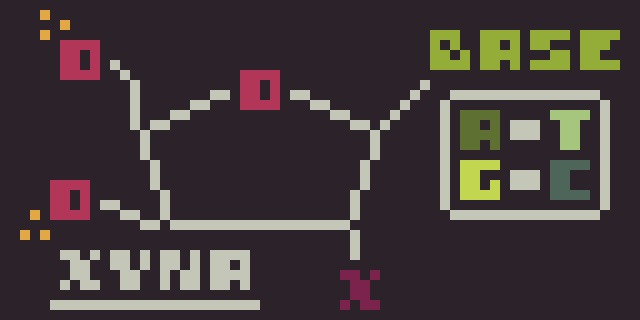
The substitution of the sugar has profound impacts on the biochemical properties of the genetic material of Lapis. Xylose-based backbones are more rigid and chemically stable, making XyNA and dXyNA more resistant to damage and oxidative stress. However, this also leads a restriction of their flexibility and capacity to fold into catalytically active structures.
It is believed that XyNA never achieved the broad enzymatic functions that RNA played in the history of life on Earth. The XyNA World was likely quickly followed by the rise of peptides, or such a peptide-based system of catalysis evolved alongside XyNA. There remains much research to be done in this field.
Last Universal Common Ancestor
The LUCA of Lapis has been approximated based on the